Publication Blog

ISM a Community Project Magazine V. 04 I. 03

Monday, October 1st, 2007

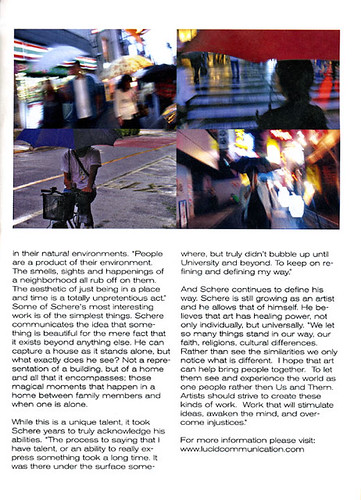
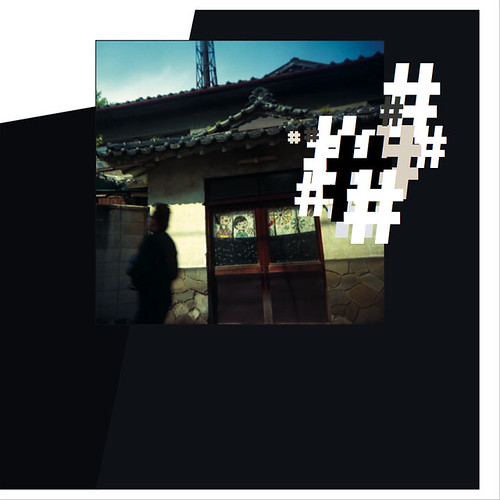
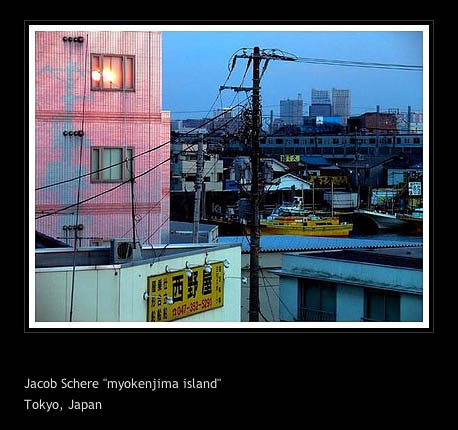
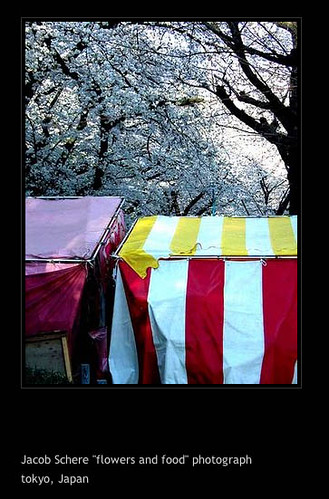
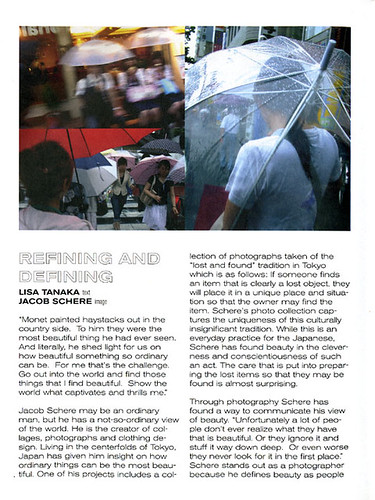
ISM a Community Project Magazine just released its autumn issue. ISM is a non-profit orgaization dedicated to the promotion and support of the arts. They distribute the magazine internationally. In the autumn 2007 issue features an article on Jacob Schere’s photographic works. Entitiled “Refining and Defining”, with text by Lisa Tanaka. In addition to that essay it features an interview with Shepard Fairey (Obey), and the photographer Diane Arbus, plus many other exciting artist.ISM Magazine is widely distributed throughout the US, Canada, and Australia. ISM: a community project is available at selected Barnes & Noble, Borders, Hastings, and a wide range of independent bookstores, newsstands and museum shops. Also available though thier website. Please support the arts and pick up a copy. http://ismcommunity.org/ISMpg01sISMpg02sHere are the images used in the article at a higher resoution.Enjoy, and again, please pick up a copy.REFINING AND DEFININGLISA TANAKA textJACOB SCHERE image”Monet painted haystacks out in the countryside. To him they were the most beautiful thing he had ever seen. And literally, he shed light for us on how beautiful something so ordinary can be. For me that’s the challenge. Go out into the world and find those things that I find beautiful. Show the world what captivates and thrills me.”Jacob Schere may be an ordinary man, but he has a not-so-ordinary view of the world. He is the creator of collages, photographs and clothing designs. Living in the centerfolds of Tokyo, Japan has given him insight on how ordinary things can be the most beautiful. One of hi s projects includes a collection of photographs taken of the “lost and found” tradition in Tokyo which is as follows: If someone finds an item that is clearly a lost object, they will place it in a unique place and situation so that the owner may find the item. Schere’s photo collection captures the uniqueness of this culturally insignificant tradition. While this is an everyday practice for the Japanese, Schere has found beauty in the cleverness and conscientiousness of such an act. The care that is put into preparing the the lost items so that they may be found is almost surprising.Though photography Schere has found a way to communicate his view of beauty. “Unfortunately a lot of people don’t ever realize what they have that is beautiful. Or they ignore it and stuff it way down deep. Or even worse they never look for it in the first place. Schere stands out as a photographer because he defines beauty as people in their natural environments. “People are a product of their environment. The smells, sights, and happenings of a neighborhood all rub off on them. The aesthetic of just being in a place and time is a totally unpretentious act.” Some of Schere’s most interesting work is of the simplest things. Schere communicates the idea that something is beautiful for the mere fact that it exists beyond anything else. He can capture a house as it stands alone, but what exactly does he see? Not a representation of a building, but of a home and all that it encompasses; those magical moments that happen in a home between family members when one is alone.While this is a unique talent, it took Schere years to truly acknowledge his abilities. “The process to saying that I have talent, or an ability to really express something took a long time. It was there under the surface somewhere, but truly didn’t bubble up until university and beyond. To keep on refining and defining my way.And Schere continues to define his way. Schere is still growing as an artist and he allows that of himself. He believes that art has healing power, not only individually, but universally. “We let so many things stand in our way, our faith, religions, cultural differences. Rather than see the similarities we only notice what is different. I hope that art can help bring people together. To let them see and experience the world as one people rather than Us and Them. Artists should strive to create these kinds of work. Work that will stimulate ideas, awaken the mind, and overcome injustices.
KRS ONE Photograph in New Times Broward – Palm Beach

Friday, September 14th, 2007

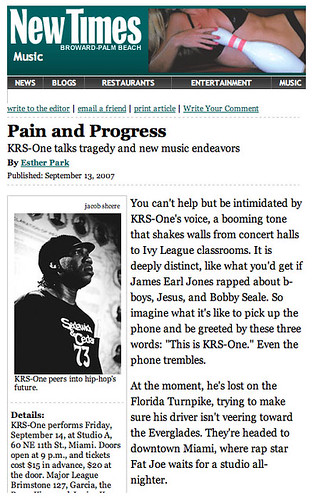
One of my fabulous photographs of KRS ONE the Teacha, just came out in the New Times Broward – Palm Beach edition. It is also accompanied by a wonderful article by Esther Park. Unfortunately they published my name incorrectly. It was published on Spetember 13, 2007. Enjoy a few words from the Teacha.

Click the link below to read the whole article.

http://www.browardpalmbeach.com/2007-09-13/music/pain-and-progress/

KRS ARTICLE

Photo By Jacob Schere

krs01

m2c on Diesel Cult’s Website

Monday, September 3rd, 2007

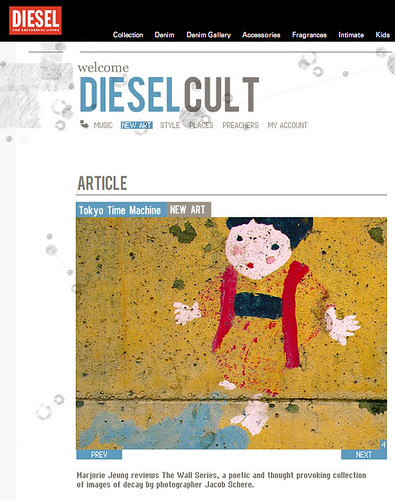
Jacob Schere’s upcoming photographic series on walls on the hip Dont Magazine was reviewed on Diesel Cults website. It’s just a taste of the multi media expierence that Dont Magazine will bring to the series.

Click the link below to take you to the Diesel Posting.

Diesel Cult Website

Follow this link to take you to Dont Magazine.

Stay posted for when the next issue drops. More photos, muisc and mash ups to come.

Dont Magazine

dieselcult copy

a copy of the text is below.

Marjorie Jeung reviews The Wall Series, a poetic and thought provoking collection of images of decay by photographer Jacob Schere.

Following on from New York Inflections in issue 4 of dontmagazine.com, we go to Tokyo where Jacob Schere takes us on a journey through time. He writes, ‘Here in sleek and ultra modern Tokyo lay images left to peel slowly off the wall. These images are of recent ancient history. Flake by flake they peel from their cement base – like an archaeologist dusting off the centuries to discover a city in ruin, I have discovered these paintings on a wall, left to grunt against the elements.’ Schere is a New Yorker living in Tokyo. He is from a city that’s built for speed but even he is taken aback by the pace of change in his adoptive home. These images of an arrested civilisation located in a kaleidoscope of tenses echo our condition. Their elegant erosion, nobility in neglect and haunting sense of devastation recall our wastefulness and our own inevitable decrepitude. A friend writes, ?????Yes, I love them! Their colours as well as their fragility and how in every flake and peel a new history is added, the pollution where seagulls cannot dive and the sublime intimate connection of two people hidden in the mist-‘

Underworld Magazine Issue #4: Graff Happening Yutenji Tokyo

Tuesday, August 21st, 2007

Hipster NYC based Underworld Magazine has just relesed its most recent issue.

Filled with art, stunning visuals, and hot photography. Including a section on the

Yutenji Graffiti Happening.

Be sure to stop by

Underworld Issue #4

http://www.underworldmagazines.com/issue1.htm

Underworld Magazine Website.

http://www.underworldmagazines.com/

Underworld Magazine Myspace Page.

http://www.myspace.com/underworldmagazine

underworld copy

Book Cover Photograph for “Como Volver Casa Pero No”

Friday, August 17th, 2007

Fernando Prat’s new book “Como Volver Casa Pero No”, ISBN: 978-1-84799-993-1, of poems features the cover photograph taken by Jacob Schere. The book is a collection of love lost, love found, love that is unreturned. Please stop by and pick up the book.

Available from Lulu.com and starting this August it’ll be available at Amazon, Barnes & Noble, Borders, Tesco, Loot.co.za, Buy.com and other stores.

como-cover

The photograph was taken with a Holga camera on a recent adventure in Paris. The text reads Je Vous Aime, which translates into English as “I Love You!”

Off Zen Gallery: Everyday Life by Jacob

Monday, August 13th, 2007

Just published on Off Zen’s website a view of 21 images of the beauty of the everyday life.Drop by and check it out.http://www.offzen.org/images/jacob/offzen_jakob.html also peep out the other work on the site http://www.offzen.org/Jacob’s Viewto view thew collection please click on the photo above.

Hail, Fire, and Brimstone [Miami New Times Article]

Monday, July 9th, 2007

Hail, Fire, and Brimstone

MC, community activist, and Kendall native, Brimstone is serious about the history of Miami’s hip-hop culture

By Esther Park

Published: July 5, 2007 Miami New Times

brim-haiti

Brimstone

Photo By Jacob Schere

“Brimstone127 is like the Biscayne Boulevard of Miami hip-hop,” quips local musician Buffalo Brown. “The man is a staple down here. You cannot talk about Miami hip-hop without mentioning Brimstone.”

Bold statements indeed. But while the usual local suspects may have gotten more mainstream shine, Brim, as he’s known for short, is the glue that keeps together a more down-to-earth segment of the scene. If Pitbull is hip-hop’s self-proclaimed “Mr. 305,” Brimstone is definitely 305’s “Mr. Hip-Hop.”

The one thing that hip-hop has taught me was unification,” he says, “seeing all these different people coming together regardless of race, age, gender. That’s what hip-hop means to me.”

Now 33 years old, Brimstone, real name Seth Schere, has been bringing folks together in the name of hip-hop for years. His first bout of rallying, by his account, came at age ten. Having just seen the classic 1984 movie Beat Street, he persuaded elementary school friends to start a break-dancing crew.

His most recent project resulted in the track “K+RS=One,” a collaboration earlier this year among twenty Miami MCs uniting to pay tribute to pioneer KRS-One. The track and its accompanying video have been getting a fair share of YouTube plays and MP3 exchanges. In a world of over-the-top egos and best-of-the-best rapper’s delight, to gather so many MCs to spit only four verses each, about someone other than themselves, was a near-religious miracle.

A first meeting with Brim reveals an ???ber-positive, ???ber-enthusiastic personality that seems borderline Evangelical preacher mixed with kindergarten teacher. He begins and ends every greeting with bless, and never utters a curse word. His optimism translates into his music, released under the collective moniker Brimstone127 (127 being the street on which he grew up).

The group comprises him as lyricist, Mariposah as background femme vocals, and Jase as DJ and professional beatboxer. The trio’s music is socially conscious and uplifting; at times it’s silly, which makes it all the more pop-radio catchy. “I don’t go gangsta rap,'” Brim confesses. “I make music that my ten-year-old daughter can listen to.”

The 2004 LP, Metamorphoses, became a hit on college radio stations nationwide. Brim’s latest full-length offering, Elevator Music, released this past May, has upped the ante, with guest rhyming appearances by KRS-One, Busy Bee, and Mr. Long of Black Sheep, as well as production work by Dug Infinite. While most artists are comfortable staying behind the mike, Brim’s can-do attitude has taken him in front of countless classrooms and inner-city youth programs. He teaches youngsters real-life survival skills through hip-hop culture.

“This is the guy who would teach kids how to break dance at the local Jewish Community Center,” recalls Omar Clemetson, a childhood friend. “There’s nothing that Brim wouldn’t touch. If there’s an outlet for him and hip-hop, he’ll be right up there!”

Born and raised in Miami, the Kendall native grew up in an affluent Jewish family. Both parents are attorneys, and his older brother is a successful photographer. “I had a happy childhood,” Brimstone remembers. “I was an outgoing, innocent kid, yet my curiosity would get the best of me.” As is typical of the suburban curse, Brim was a bit of a misfit growing up, he admits. “I was a professional shoplifter,” he says, laughing. “I would steal anything — records, books, food, women’s stockings, anything!”

Later he became an active graffiti writer. His first tag, bestowed upon him by Miami’s AIM Crew — BRIM — was an acronym for “Born and Raised in Miami.”

“That was like in 1987. By then hip-hop was at its finest,” he says. “Criminal Minded [by Boogie Down Productions] just came out; Public Enemy’s Yo! Bum Rush the Show was out; Eric B. and Rakim’s Paid in Full was out. I mean, cats like Biz Markie, Gang Starr, Kool Moe Dee — this was the hip-hop that I grew up on.”

Upon entering Killian High School, Brimstone gave up his spray can. He became friends with a New York transplant named Dionne, who, in Brim’s words, “dressed like those dudes in the music videos.” With Dionne’s baggy pants and wild color combinations, and Brim’s white-boy suburban appearance and a bit of street cred, the two outwardly made an odd couple. But his friend’s influence was major.

“I started writing rhymes and getting really into music because of him,” Brim says. “Back then there were no white rappers out there. I mean, this was before 3rd Bass even came out! Dionne would always tell me: ‘Yo, you need to stop sounding white!’ Needless to say, we were ahead of our time.”

The two quickly became inseparable and decided to start a hip-hop group they called Plan B. They recruited several other members to be part of the MC lineup, making Plan B one of the first hip-hop crews to come out of Miami’s southern suburbs. By 1991, a seventeen-year-old Brim dropped out of Killian High to take his music career full-time.

Plan B released two full-length albums and produced more than 100 mixtapes, all of whose masters Brim proudly proclaims he still has, on cassette. And if that isn’t historical enough, Brim has been credited with launching Coconut Grove’s first hip-hop venue, the Zoo, in 1991.

“You got to remember, back then Miami was all about bass and freestyle. There was hardly anywhere to go to hear hip-hop music,” recounts Brim. “You look at South Beach now and there’s hip-hop clubs everywhere. But when I was growing up, there were only two spots that played hip-hop music, the Junkyard and Fifth Street. Then the Zoo came along.”

A venture Brim began with a cousin, the Zoo packed the house every Saturday night. Each week more than 200 of Miami’s biggest hip-hop lovers would go to hear local DJs like Coupe de Ville and DJ Kris. One night a freshly plucked thirteen-year-old got on the decks. His name was Aristh Delgado, and it was his first DJ gig in front of a live audience.

“When I see DJ Craze now, we laugh about that gig,” Brim says. “He could barely see over the turntables and he had to stand on milk crates!”

Brimstone is famous for these stories. Deeply rooted in the local hip-hop community since, well, the beginning, he has no qualms about saying, “I was a part of that,” when describing Miami’s momentous hip-hop occasions.

His latest endeavor has been to gather traces of all of these historical moments and house them under one roof. “I’m in the works of starting a hip-hop museum down here,” Brim says. “People from the Miami hip-hop community have been giving me all these mementos that are truly Miami hip-hop artifacts, like old-school flyers and demo tapes. It’s just been this amazing journey that needs to be documented.”

But with the amount of blood, sweat, and tears he has given, the Billboard success of other local acts has eluded him. He remains serene about it.

“It’s out of my hands,” he says calmly. “I tried as hard as I can, and I have pursued those avenues of trying to make a hit record, but nothing ever comes up.” He pauses solemnly and then continues.

“People measure success as money, but I measure it as a dream. And you know what? My dreams have already come true. I mean, I’ve always dreamed of working with KRS; now he’s a personal friend of mine. I always dreamed of working with De La Soul, and I’ve been in the studio with Maseo. I can stop right now and say that I have had an extremely successful music career. In that sense, who cares about that major-label deal. I literally made it.”

link to where original article was published.

http://www.miaminewtimes.com/2007-07-05/music/hail-fire-and-brimstone/full

link to brimstone’s home page

brimstone127.com and myspace.com/brimstone127online

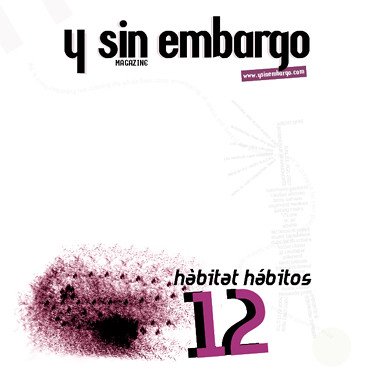
Ysin Embargo Magazine Issue #12 Habitat Habitos

Sunday, June 24th, 2007

The wonderful magazine Ysin Embargo Issue#12 recently was published with Jacob Schere’s images setting off the mood for the issue. Described by the magazine as:

“the habits of our habitats. Or… habits of those little things that doesn’t appear on tourist-guides but they’re what we remember of cities. Details. The gap between the “modern way of living” and the way most people actually live. Routine’s things. The paradox of an everexpanding interconnected world and people every time more alone. The superficial way of nowadays relationships.”

I explored my surroundings here in Tokyo. What is it that I see everyday in the world that surrounds me. The boy playing on the jungle gym, or the waterway I pass everyday in my comings and goings. In addition other great artist came out in the same issue such as JP Candelier and “R” ZoneTo view the entire issue plase visit the Ysin Embargo Website.To view my images from the magazine please click on the slide show below.yse12_cover


Moving Earth with AFH [ Art for Humans ]

Tuesday, June 12th, 2007

Another fine production from the world of Art for Humans. The current theme is movement. That is movent in sense of transportation and getting images from trains, planes and automobiles anythng that moves the masses. Diya Sarker of India, others along with I are featured to this project. In addition, AFH has opened a new art gallery in Chinatown in Los Angles, so if you are there in LA go check it out.Art for Humans Gallery Chinatown945 Chungking RoadLos Angles, Ca212-621-7685to view my submisson as slides click hereto view all the wonderful art on Moving Earth on the Art for Humans website click here.

TalibanAmerica: Chuo Koron Magazine 2002

Friday, June 8th, 2007

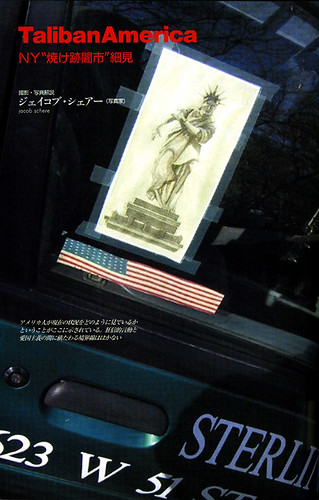
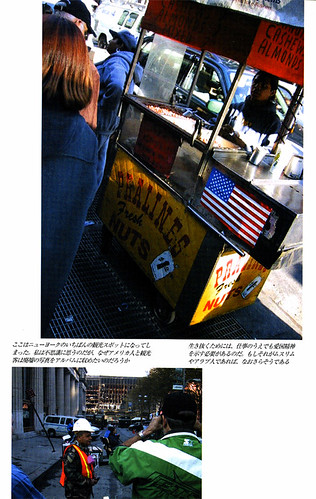
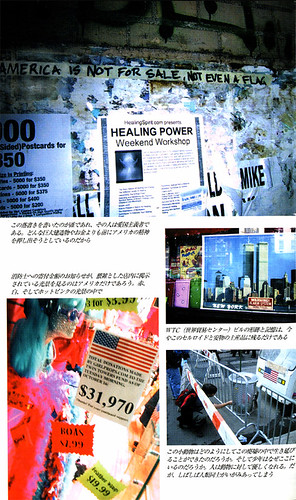
I wanted to post this article of mine that was published by the Japanese magazine Chuokoron [ Central Review ] Magazine back in 2002, April . It was my reaction to the events of 9-11 when I visited the devastated city in November of 2001. It was the first time that an editor asked me to write about the images that they published.

page01

page3 copy

page2 copy

page4

Below is a translation of the article written by Akasaka Mari, and my comments on each picture.
1. This is how most Americans see our current situation ;however, there is a thin line between fanaticism
and patriotism.

2. In order to survive you have to show your patriotism on your place of business. If you happen to be Muslim or an Arab then you have to prove your patriotism even more.

3. The site has become the number one tourist attraction in NYC. I wonder why Americans, and tourists would want to keep photos of the destruction in their family albums.

4. Whoever put this graffiti up in my eyes is a true patriot. They are putting America ahead of any fabric, paper or dollars.

5. All that are left of the WTC are images, memories preserved on celluloid, and cheap souvenirs.

6. Only in America can I find whips, feather boas, and how much money has been raised for the fire fighters fund. Red, White and Hot Pink.

7. How did this tiny creature survive the destruction and why is this boy here. Humans can be kind to animals but often he are inhumane to other humans.

8. People should think about similarities between cultures; however, it is easier to point out differences and use that to subjugate them.

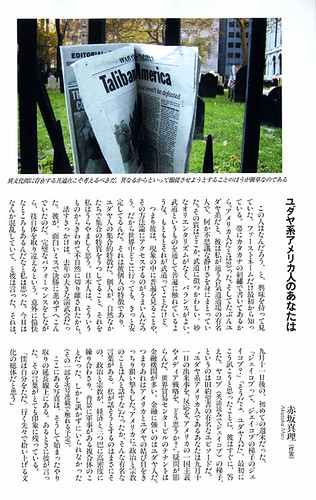
You are a Jewish American
by Mari Akasaka

I have been wondering who is this person? I only know his first name because his name is embroidered in Katakana on his Aikido belt. I figured out that he is American and probably Jewish. He stands out at the Aikido dojo where I go. He has some sort of mystic silence about him. This somehow reminds me of Budo [martial arts.] Not too oreintalistic but balanced. It’s like touching universality through Budo. Budo itself is that. In other words, he’s good at seeing the universality in his pictures, and accessing that methodology. That’s why wherever he is, he is balanced.

That is a characteristic of his personality and the Jewish collective personality. I’m envious of someone who naturally reflects the characteristics of his group. Japanese tend to be apart from that. The first time that I talked with him was at last years big Aikido Demonstration. He was a little bit down because he made an interesting mistake whereas he wasn’t able to make it to the finals. He performed perfectly but it wasn’t the correct technique. I found out that he has a light-hearted side. “I was confused today,” he said. That was the first weekend after the September 11 incident. “Is Jacob the disciple of Yakov?” I asked. “That’s right, I’m a Jew.” he replied. I wanted to ask this question first but he answered it right away. The story Yakov [ Jacob ] is from the Old Testament. “What do you think about the incident, the people’s reaction, the principles of Americanism and the strategies of the Media as a Jewish American?”

These questions grew in my mind. There were so many financial agencies in the WTC. Jews have traditionally been strong in this field, that means it aimed right at the point of connections between Jews and Americans. I think there is a famous saying in America “Don’t talk about politics and religion” What I’m trying to say is that there is a complex that is politics, religion and economics are intensely interconnected and there is a military behind it all. I had to ask these questions. [ These might be in the next issue ] The pictures are an extension of these conversational exchanges. One day he said some impressive words, “I have no culture, I only have the bits and pieces of culture that I have picked up along the way.”

Photos and description
Jacob Schere

Essay
Mari Akasaka

Published
Chuokoron [ Central Review ]
2002, April

Burrow Magazine

Friday, June 8th, 2007

Recently came out in the new online magazine Burrow Arts. A collection of fresh art in various mediums. Also in the same edition the photographic stylings of my friend Be.

Click here to take you to Burrow Magazine to see the whole issue.

burrow02

burrow01

Blackpool #6 Saguragicho Street Art Article

Friday, June 8th, 2007

Here is the first of many to be collaborations between the French magazine BLACKPOOL and m2c. The article I wrote is about the street art scene in Tokyo and the Yokohama street art happening. Unfortunately the article is only written in French. Enjoy the magazine.

Click here to take you to the BLACKPOOL home page.

Click here to take you to thier Blackpool myspace page.

cover_breadandbutter

blackpool6_82-83

Here is the English unedited article. Originally published by Blackpool Magazine May 2007

Saguragicho: Street Art Haven

So are you down for some super heights street art? Get your respirators on, brushes in hand, cans shaken just right and let head out to Yokohama. Street art has a vibrant subculture in Tokyo and its surrounding neighborhoods. All styles were represented from wheat pasting, stenciling, stickers and of course graff. One stop on the Kehin-Tohoku train line past Yokohama, lay a 1 km wall of graff and street art. Over a one-month period SOTW [Saguragicho On The Wall] sponsored by Kompostion, and the city of Saguragicho artist gathered and bombed the walls with colorful expression. Artist from all over Japan and the world splashed paint on the walls at the weekend jams from Feb 3rd to March 4th 2007.

Here in Japan, not only is graffiti against the law its is barely understood by the city dwellers. Some of the younger generations are hip to the street art stylings even if it is an underground subculture with in a subculture of Hip Hop. Some Tokyo neighborhoods like Shibuya, Naka Meguro Shimo-Kitazawa and Kichijyoji walls are covered in paint. Rakugaki [literally: intention less drawing], the traditional Japanese style graffiti is usually in the Akira loves Yoko fashion, or written by the Bozozoku, Motorcycle gangs who mark out their territory with drippy black Japanese characters. Good spray paint is a bit harder to come by so writers often swap caps from other kinds of spray cans in order to get the lines and spray patterns they are looking for. There is an on going battle between the local communities and the writers; some spots are buffed almost as soon as they get bombed. Other neighborhoods because there is so much graff writing the buffing is less frequent. The hippest writers scout out areas that don’t get buffed or they wait for the legal pieces. Graff in Japan was the last of the elements of Hip Hop culture to reach the streets, and still the writers are behind the pioneers in the US or Europe. It hasn’t reached a level of mastery or popularity as it has in the rest of the world.

VERY and BASK are considered to be the top writers around the city. Most of their pieces up are legal pieces, and VERY has exhibited in galleries. The writer EKYS has caught the most fame as a mad bomber with tags, throw ups and small pieces all over Tokyo. Next time you are in Tokyo you are bound to see EKYS posted up somewhere in the city. The penalties for getting caught are severe and those busted will have to reimburse private citizens for thousands of euros in damages. Most Japanese writers don’t start writing until their 20’s, where as; in the states most start off as teenagers, obsessed with the adrenaline thrill of jumping fences and doing illegal pieces. The writers I met we surprised by the youth of UK writer MIRA at age 24. Painted subway cars are pretty much unheard of here. MIRA kept asking the other writers “Do you paint trains?”?? The resounding answer was ?????NO, it is very difficult!????? they all said they were afraid of getting busted painting on trains. There were dozens of video cameras set up by the Japanese writers when they did the legal pieces. They are pretty serious about the whole documenting the process of changing a blank wall to one covered with aerosol paint.

Each artist and or group registered for space in Saguragicho and was given a 5m by 4m piece of the wall per person to do with whatever they pleased. Nike provided all the participants with nifty black SOTW windbreakers. It would have been better if Nike had provided cases of paint! In contrast to sponsored jams I’ve been to in the States, where Rustoleum or Krylon had donated cases of paint here in Saguragicho artist had to supply all their own materials.

I met a group of fresh graff writers all the way from Peru who are currently based in Yokosuka, Japan. It was a jambalaya of language because the common tongue was Japanese, spiced with a bit of English and Spanish thrown in. A big shout out to the whole Peruvian krew: KEP, EKC, BAMC and LI3.

Street art is about pure expression, uninhibited by society. A last resort to reach out to the community and make your voice heard. Whether its purely about catching fame, taking a stance on a social issue, or Questioning authority, art on the wall goes way back, and its good to see it get some props out in Yokohama.

Jacob Schere
Tokyo 2007

m2c out in Belio Magazine 023 the USA issue

Saturday, April 21st, 2007

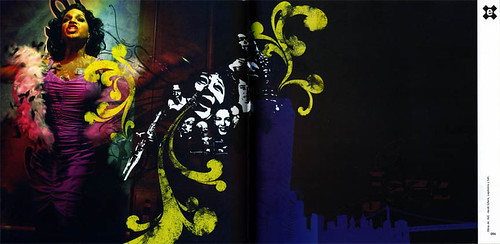
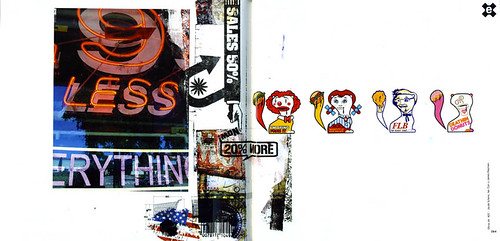
Jacob Schere aka m2c has debut in print in Belio Magazine 023 the USA issue. This Spanish experimental art and desgin magazine is a perfect match for the the fresh stlyings of m2c. The images combine Jacob’s phtography with brillant layout by Belio Magazine. A special thanks to the amazing Cheeta of NYC who is featured in the first image. The magazine can be found in Spain, Europe and the rest of the world at fine locations.

Please free to go out and get your self a copy.

belio02302 copy

Jacob Schere + Logotomia y Salt

BELIO02301 copy

Jacob Schere + Ian Carr y James Hayman

Click the Link below to take you to Belio Magazine

Belio Magazine

Tokyo Bay to San Fran Bay: COLLABO show with the Pacific Art Collective San Francisco

Thursday, April 5th, 2007

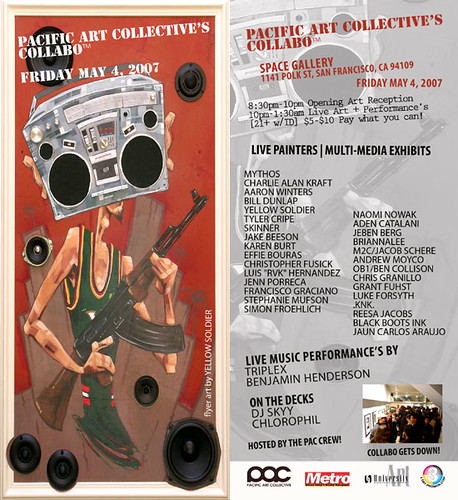
m2c otherwise known as Jacob Schere will have a series of 6 photographs on display at the COLLABO joint exhibition in conjuntion with the super heights Bay Area goup Pacific Art Collective. So, for all those hip cats out in the Bay Area make sure you hit the opening event and be prepared to see some fresh work.
WHAT:
Pacific Art Collective’s COLLABO?????
(Art Exhibit May 4 – May 28, 2007)

WHEN:
OPENING – FRIDAY MAY 4, 2007
8:30pm – 10:00pm Opening Art Reception
10:30pm – 1:30am Live Art + Performances

WHERE:
SPACE GALLERY
1141 POLK ST, SAN FRANCISCO, CA 94109

HOW MUCH:
$5-$10 All Night (Pay what you can!)

AGE LIMIT:
21+ with ID

COLLABO_MAY42007_DUAL600

For more info on Pacific Arts Collective click here

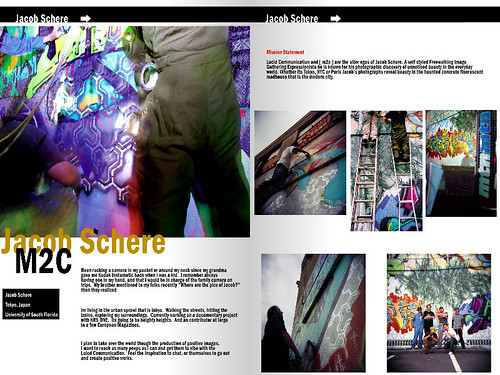
Freewalking Expressionista Photographer for UnderWorld Magazine

Saturday, March 24th, 2007

Jacob Schere has been named photographer for Underworld Magazine.

You can also check out thier myspace page here: www.myspace.com/underworldmagazine

UnderWolrd Magazines’s Mission Statement:

Acknowledge unknown artists, and through demonstration show their undiscovered talents

An emerging underground magazine that focuses on the potential of up and coming; musicians, photographers, artists, poets, journalists, film makers, fashion designers and more underground artists. If you have original work, and we feel it meets our standards we will feature you in any of our upcoming issues. Underworld magazine focuses on portraying the undiscovered in a professional way. Therefore they can get their name known and receive the credit they truly deserve.

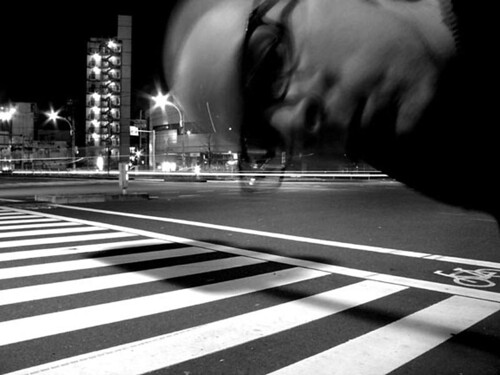
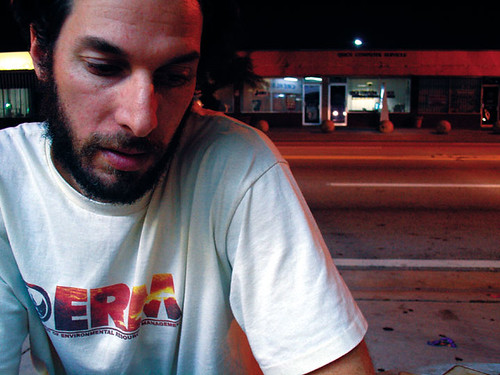
selfportrait

Copyright 2007© m2c LucidCommunication - Jacob Schere